Showing posts with label United Kingdom. Show all posts

Friday, March 31, 2023

Adventures in Wales and England with Calhoun (Part Two of Two Blog Entries)


(Mathew and I reached the summit of Mount Snowdon, the last of the peaks in the Welsh 3000s hike.)

In case you missed it, to catch up on the first week of our trip, please read the first of these two blog entries: Escapades inIreland and the UK with Calhoun (Part One of Two Blog Entries).

This blog entry documents the second half of my summer trip with Mathew Calhoun last year In Ireland and the United Kingdom (UK). During this leg of our two-week adventure in August, we explored England and Wales.

After our time in Ireland, we boarded a 6:00 am flight to Liverpool, England, via RyanAir, arriving at the airport shortly after 3:00 am. Multiple locals advised us to arrive on time due to a shortage of workers and thousands of visitors traveling through the Dublin airport.   

Of all the places we visited on this trip, Liverpool was my favorite area. Some features of Liverpool shared common traits with London, however, Liverpool possessed its own identity and rich history. Since we arrived so early in the day, Matthew and I explored much of the city. Our first landmarks included stops at St. Luke's Bombed Out Church and the Liverpool Cathedral. St Luke's Church was air raided by the German Luftwaffe during World War II. Ironically, the church foundation and walls still stood erect, everything except for the roof. The edifice was open-air, and the architecture possessed its own unique charm. In addition to some statues, gardens with several blooming roses surrounded the grounds.

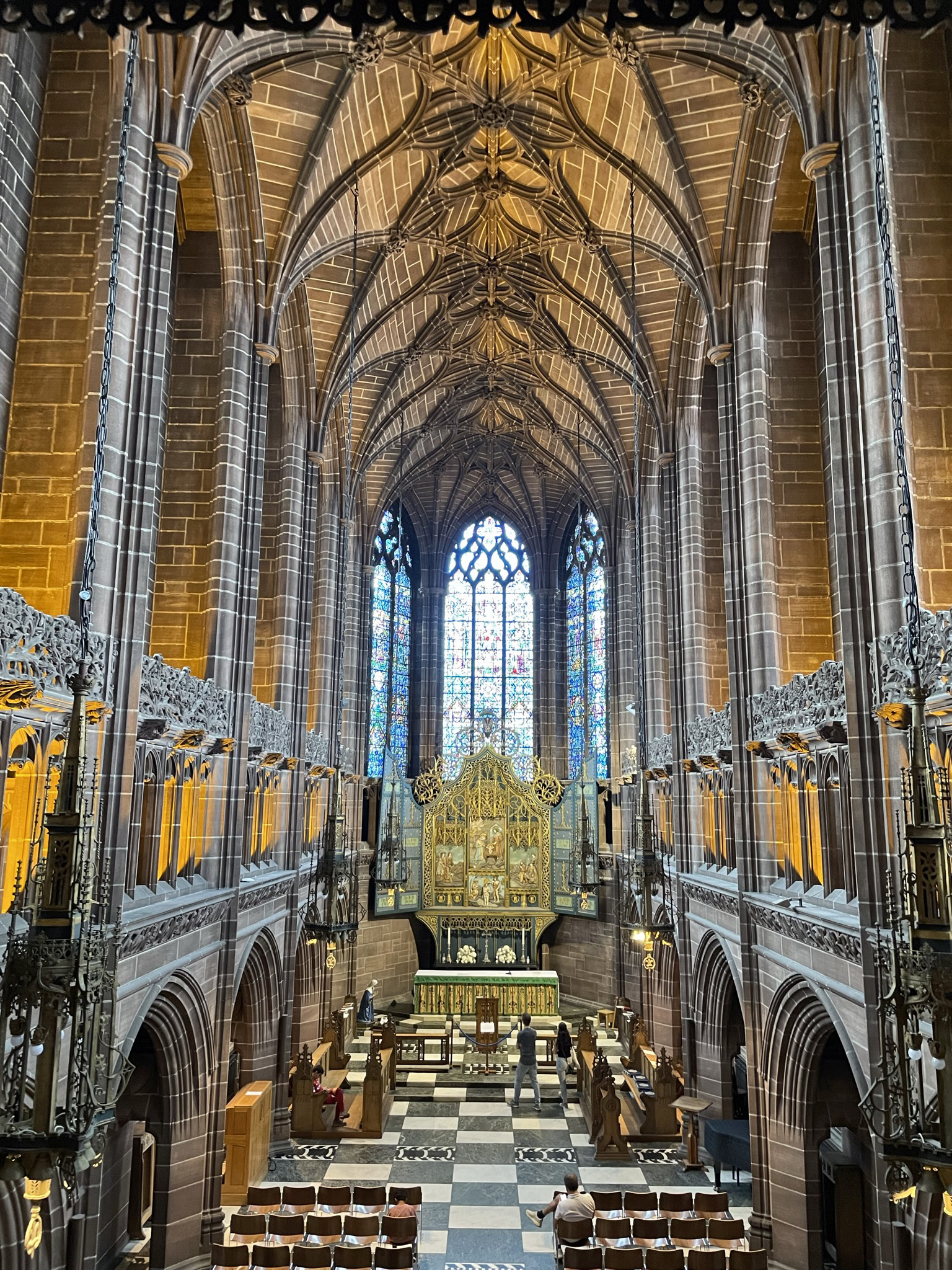
Next, the Liverpool Cathedral seemed like its own country. It was massive both inside and outside! The church exhibited some large-scale artworks by Peter Walker. While Walker's pieces were quite interesting, I found the display of these pieces to be a little odd inside the structures of a holy place. It made the church feel touristy rather than reverent. For a small donation, Mathew and I climbed two elevators and several steps to reach the summit of the bell tower, where the views of Liverpool appeared spectacular. The clear skies presented the ideal imagery for a panoramic photograph. You could also observe the other known landmarks of the city from high above.

Mathew and I ventured to find the Beatles statue, near the Albert Docks. The famous English boy band was from Liverpool. Mathew was intrigued by the narrative of how this known trio emerged with a clear mark on history. In addition to the Beatles, Liverpool possesses a strong past as a port town, shipping trade goods all over the world. While commerce still seems rampant through Liverpool, it appears reduced compared to past levels in the city’s maritime history. The Albert Docks consists of elegant restaurants, souvenir stores, art galleries, several museums (all free to enter), and a spectacular view of the waterways. We then visited The Cavern Club and Mathew Street, where the Beatles played close to three hundred times. Resembling an underground cave, The Cavern plays music around the clock. Mid-afternoon, we grabbed a few beers and enjoyed the live music. For quick viewing of the local sites, we rode in a twenty-four-hour drop-off/pick-up bus meant to route visitors to the tourist attractions throughout the city. After a full day of activities, we ate dinner at MADRE Liverpool. This Mexican establishment maintained a flare of American Tex-Mex spice. 

We stayed one night in the Posh Pad Apartments. Rather than a traditional hotel room, we occupied a spacious, clean apartment with a kitchen, dining area, and den. For the rate, it was an exceptional stay! The rates for every activity and accommodation in Liverpool were a fraction of the price of our time in London. Ian, the driver and entrepreneur of MADD Day Out Beatles Tours, chauffeured us around for approximately three and a half hours to visit many historical sites of the band around Liverpool. These sites included the childhood homes of each band member and Strawberry Fields. After the excellent tour ride with Ian, we made one last stop at the Maritime Museum at the Albert Docks. The museum showed two immense exhibits of the famous shipwrecks, the RSS Titanic and the RSS Lusitania. The Titanic ship was designed in the Albion House, the previous headquarters of The White Star Line. This company was known for building state-of-the-art cargo and passenger ships.        

After we visited the naval museum, Mathew and I caught a train from Liverpool, England to Bangor, Wales. In Bangor, we ate dinner at the Wood Fired Shack, a pleasant pizza eatery for those with casual travel wear. The restaurant was nestled next to ancient churches and castles. Near the town square (close to the restaurant) was a large, abandoned cathedral. It seemed out-of-place that this landmark stood empty in the middle of a noteworthy Wales town. It still functions to some degree, yet it resembled a barren warehouse without stored products. A university administration building was just beyond this church on a hill overlooking the town. This campus structure resembled a modern castle. While appearing somewhat like a ghost town, Bangor possessed its own appeal.  

Our trail guide eventually picked us up at the restaurant in her caravan, which could comfortably sit 10-12 people with her larger groups. We stayed in a private room at Totters Hostel in Caernarfon during our first night in Wales. This accommodation was clean and comfortable. The building was previously a residence that the owner now turned into a hostel. Most of the town stood within the walls of the historic and still-standing Caernarfon Castle. In other words, the town was the castle. The town sat on the edge of a body of water. The surrounding hills of the countryside made for a picturesque image of what medieval times might have looked like. Shortly after arriving at Totters, we ventured to the Black Boy Inn, another local establishment. The Welsh pub within this inn felt like a scene in a movie. The inn was built circa 1522 and is still family-owned. Multiple theories exist as to why the name fits the inn. One story relates to a black navigational buoy in the nearby harbor. According to another account, a known black boy was brought on a ship into the country through the nearby waterside and worked several years at the inn. 

Over three days, we planned to complete the Welsh 3000s in Snowdonia National Park. This hike encompassed fifteen summits of mountains over 3000 feet, covering approximately thirty-two miles. For the trek, we hired a private guiding company that offered a glamping experience with mattresses and a circus-sized tent for two nights during the hike. We covered eighteen miles on the first day, thus finishing most of the hike on our first day.

Our main guide was concerned with making good time, however sometimes overlooked our enjoyment of the actual hiking experience (breathing, absorbing the moment, and marveling at the scenery). This adventure was my first time in the national parks of Wales, and I sought to gaze at the majesty of these green mountains. This creation appreciation mentality is not an approach I typically rush through.

To better enjoy these junctures and maybe because I was a little annoyed with our guide, I asked if I could take an alternate shorter route the next day with some waterfalls (not just hills, rocks, and goats). There is not a wide selection of wildlife in Snowdonia National Park, literally birds, bugs, and goats. Mathew and I split up for most of the second day of our hike, and he completed the middle section of the full trail route. 

On the final day, due to rain conditions (and for safety reasons), the guide suggested that we start at 1:00 pm and hike into the evening. This delay permitted us to revisit Caenarfon and tour the inside of the castle. Of the many castles and architectural wonders we visited, this site was the most impressive with the well-maintained grounds and the museum collection. All aspects and parts of the castle were open for exploration. Some castles in the UK have limited viewings with residents still living in the structures. I also had some extra time for light shopping near the town square.

I again decided to take another alternate route that mounted the last three peaks on the trek the third day. Mathew took a path that required several hours of free climbing, bouldering, and generally some unsafe situations that involved risks. In some places, Mathew was free climbing without a rope and a harness.

To carry mountaineering gear and physically climb in Wales, this qualification necessitates a license our leading guide did not possess. However, there were sections of the trek that would have been safer with rope, a harness, and some other climbing essentials. If you seek to hike the Welsh 3000s route, check your guide's credentials. Make sure they are certified in both trail guiding and rock climbing with the right gear.

We all finished the last portion of our trek at the summit of Snowdonia. Upon later reflection, Mathew and I could have self-guided the last three peaks, stayed in the town of Snowdonia, and had a similar quality experience for a fraction of the price for a guide. It depends on what you seek to do with your time while visiting the UK.

I covered about twenty-five miles of the trails in the Welsh 3000s. Mathew covered the entire thirty-two miles, crossing all included summits. We stayed the last night of our trip at the Royal Hotel Victoria Snowdonia, which was a splendid choice after three long days of hiking. The beds felt like cushioned heavenly clouds, and the warmth of mountain water in a real shower brought new meaning to missing these first-world luxuries. The breakfast we had the following day was pristine! For a moderate price, we had many choices for a traditional Welsh morning cuisine.

With five days remaining in our trip, we went to London. Riding the train from Wales to London was problematic because it was overcrowded and operationally unsafe. People stood in every available space, even between cars next to the bathrooms and doors to get on and off the train. Many of the train operators were said to be on strike for unknown reasons, which made the journey very uncomfortable. Clean and fluid transportation was a challenge throughout the UK. On the other hand, public transportation in Ireland was smooth and much less expensive than in the UK.

Because of the constant train delays, we arrived at our hotel, Melbourne House, much later than expected. Melbourne House was in the Westminster neighborhood, central to all the major sites in London. It was sweltering in London when we visited, and the humidity remained throughout the late evening and early morning. The heat made it a little hard to sleep each night.

Once settled in, Mathew’s immediate question sunk in, “What would you like to do?” In less than an hour, Back to the Future, The Musical, would set the stage and begin with a memorable performance. I really wanted to go to the play; however, Mathew and I delayed buying tickets, knowing and expecting the multiple issues with transportation in the UK. In other words, we did not want to purchase tickets and miss the play due to these unnecessary delays. We decided to grab a quick taxi to see if we could buy tickets and catch the play a few minutes before it started. We were successful in doing so! And it provided for a fascinating first evening in London!

I love the three movies that make up the Back to the Future trilogy with Michael J. Fox and Christopher Lloyd! Both characters in the musical played the depicted movie characters with precision and personality. The same Huey Lewis and the News tunes on the movie soundtrack resounded on the stage with a strong presence of special effects and dance numbers from the cast. The historic Adelphi Theater provided a beautiful backdrop for the DMC DeLorean time machine to appear as if flying just above the audience and under the ceiling of the building. The flux capacitor abilities impressed the audience of science fiction fans!

For our first full day in London, we stopped at the London Eye, the world-famous cantilevered observation wheel. It is the tallest of its kind in Europe. The wheel moves very slowly, so individuals take advantage of the views and vistas from various high points. Groups of people stand or sit in a large glass room that looks like a pill of medicine. Several of these glass caravans on the Ferris wheel rotate through the entire wheel. The London Eye sits in an area on the Thames River called the Southbank Centre. There are some green spaces and other smaller tourist attractions here as well. During our walk to the London Eye, we stopped to admire Big Ben (nickname for the Great Bell of the Great Clock of Westminster at the north end of the Palace of Westminster) and Westminster Abbey Church. The Great Clock of Westminster resembles a historic tower with a noticeable clock at the top of the building, viewable from miles around. 

Our next stop was the Charles Dickens House and Museum. Of course, as many book lovers know, Charles Dickens is the author of The Christmas Carol, David Copperfield, Oliver Twist, and many other literary texts. I marveled at how many words Dickens could write in a short period. I enjoyed seeing one of his main writing desks and learning about the Dickens family. Mathew desired to see a Champion League soccer game (more popularly known as football in Europe). The home team, West Hamn United F. C., was playing Manchester City F. C. 

The game served to mark a task off my personal bucket list. It was one of those luxuries you do once to say you did it. West Hamn played their games in the London Games Olympic Stadium, which was an impressive building on its own. I am not a steady soccer fan, yet I was still surprised at how cynical West Hamn fans were towards their team. I partially expected an electric environment with cheers from the crowd, however, the fans could have been more enthusiastic. At the time, Manchester City was one of the best teams in the league, and maybe fans knew they lost the game before it even started.     

Perhaps on a more exciting note, Mathew and I planned to visit Stonehenge, Oxford University, and Windsor Castle the next day. Stonehenge was the famous circle inlay of stones in the middle of nowhere. Imagine fields for miles. In the middle of these fields, there stand rocks as large as modern buildings. Since the stones are approximately 5,000 years old, historians wonder how the stones were moved to the present-day location. Many explanations also exist for why the structures were created in historic times. First, many people have been buried at Stonehenge and near the circle of grandiose rocks. So, it could be a burial site. Second, some findings suggest Stonehenge was used for ceremonial purposes in medieval eras with royalty, knights, and celebrations for other individual achievements. Third, many theorized astronomical purposes exist for the grounds, such as tracking the movement of the moon, sun, and planets. Some have even claimed the stones possess supernatural powers, perhaps once used for spiritual purposes in life and death rituals. Regardless of the reason for its existence, Stonehenge was magical! While some visitors only notice large rocks in the middle of the field, I see a landmark built for wonderous purposes (and maybe some tragedies) through many ages for those who lived there.        

Windsor Castle limited what sections visitors were previewed to as one of the royal residential sites. No photographs were allowed within the castle. So, viewing the few rooms experienced seemed minimal for the hours one could really spend touring the buildings. One part of the castle included an impressive weapons collection – spears, knives, swords, javelins, and multiple sets of armor for combat. This collection was pristine, well-maintained, and shiny.  

Oxford University was made up of several colleges within the system, however, these smaller colleges were not limited to only specific majors like higher education in the United States. They operated as their own mini colleges, integrated into the overall Oxford University as an institution. The mini campuses were stunning, but many were closed to the general public. Walking around the campus, you could get an overall picture of how the university operated. Several scenes in the Harry Potter movies were filmed in the buildings and on the campus. 

I visited the Winston Churchill War Rooms on our last day in London. These underground bunkers served as a historical landmark where Churchill spent most of his time as commander-in-chief during World War II. The Germans constantly bombed London throughout the war, and Churchill remained protected in these chambers from the constant bombardment. Now a museum, the tour of the facility presented a unique lens into the experiences of London citizens at the time. I cannot imagine living in this heated environment, fearing for my life daily. I walked through Hyde Park and St. James's Park to appreciate the natural scenery amidst the city. I stopped by to peak through the gates of Buckingham Palace, the home and administrative center for the British royal family. The surrounding gardens and gates of Buckingham Palace looked heavenly, literally some parts with statues of angels and trumpets. I walked across Tower Bridge and toured the inside workings of the draw bridge. Depending on the ship coming through on the Thames River, the bridge still operates to open up and down. Then boats can go through while cars wait on each end. At the top of Tower Bridge were glass floors that you could look down through and see the river below. Tower Bridge was built between 1886 and 1894. It was designed by Horace Jones and engineered by John Wolfe Barry. The mechanical operations of the bridge were an impressive feat for these men at the time of its creation. Once across the bridge, I walked by the Tower of London (different from Tower Bridge), a historic castle built by William the Conqueror. Between 1100 and 1952, part of this structure was utilized as a prison. 

The stunning architecture, scenery, and history are magnificent in London! London is truly one of the greatest cities in the world! You must visit this city in person to fathom its illustriousness.

The original intent of our trip was to celebrate my fortieth birthday with a once-in-a-lifetime adventure. I would say we did that. For a birthday gift, Mathew surprised me with tickets to the play, Les Misérables. The play was much different from what I remember and closer to the book's plot than the movies. It was a wonderful last night to a spectacular experience!

I was away from my family for about two and a half weeks while visiting these previous sites with Mathew. While Annabelle is only two and half years of age and Jace is now eight months old, taking them on longer trips is logistically more challenging. Rather than travel solo, I prefer to share these golden moments with my family. So, I look forward to sharing these international travels with the kids as they get older.

In my many adventures, I have learned that life is not necessarily gratifying if one focuses on how much money or stuff a person accumulates. Instead, I enjoy the key moments I can revisit with family and friends, sharing these experiences with those I love. If you wait for your "maybe one-day" timeframe, you may realize that day never comes for you to seize the moment and live out some of your dreams. I encourage you to live out some of your heart’s desires today! Do not wait! Because one day, it may be too late to do so.


(This is a view of the city from the top of the Liverpool Cathedral.)


(Boats floating at the Albert Docks in Liverpool.)

(The inside of the Liverpool Cathedral is breathtaking!)


(City walls in Caernarfon at night,)


(Housing on the streets of Caernarfon.) 


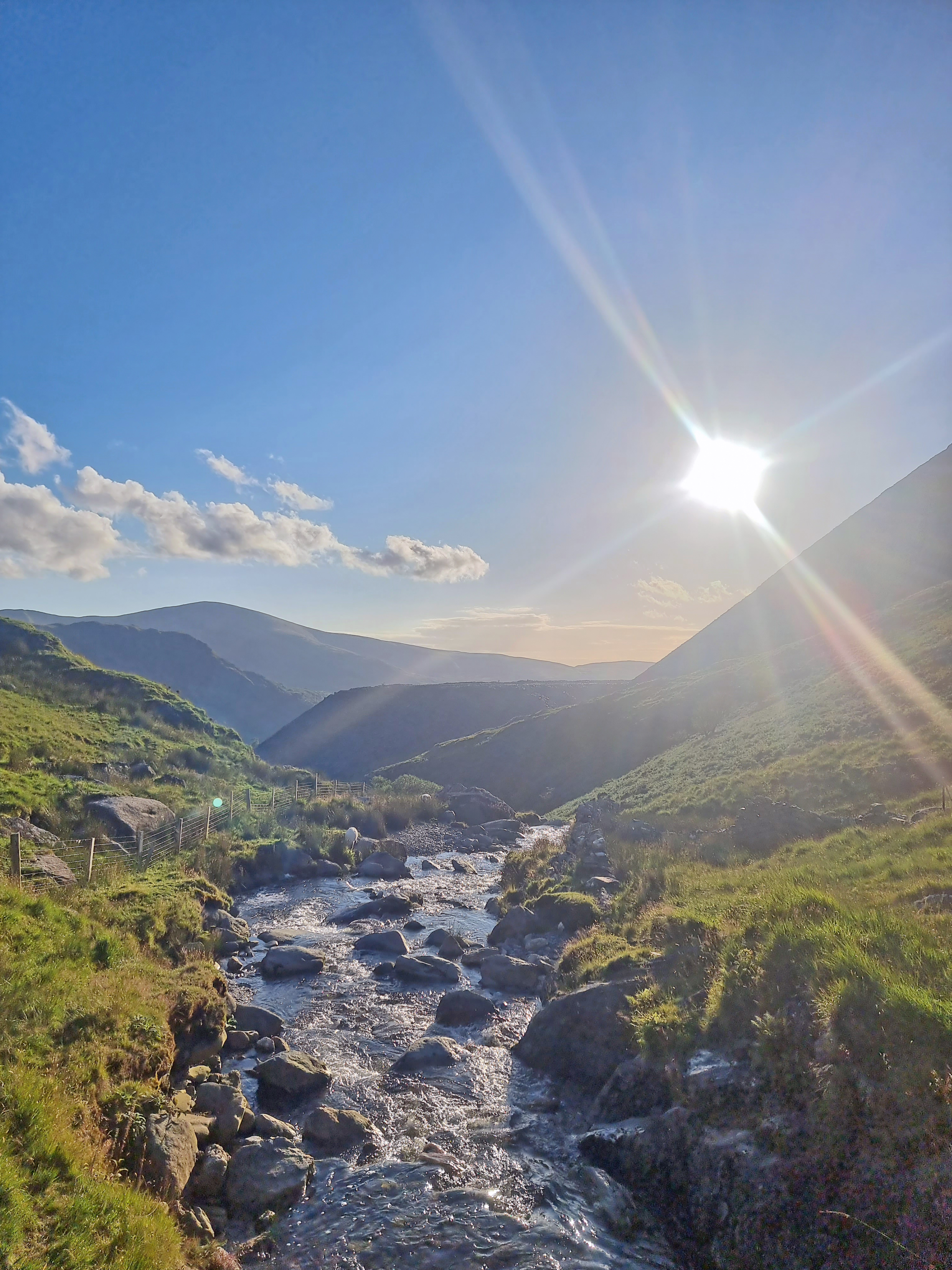
(Near the start of our three-day trek in Snowdonia National Park.)


(Near our first peak summit of the Welsh 3000s.)


(Sunset during our last day of the Welsh 3000s hike.)


(Finally, a hike with a decent waterfall source.)


(The scenery in Snowdonia National Park is stunning! As you might notice in the pictures, there are no trees anywhere.)


(The view of the town from Caernarfon Castle). 


(Big Ben of the Great Clock of Westminster.)


(The box atop the London Eye cantilevered observation wheel.)

(Looking up at the London Eye from the bottom of the wheel.)


(Charles Dickens’ desk in his home museum.)


(Royal Naval Division War Memorial.)


(View of Tower Bridge from one side of the Thames River.)


(Windsor Castle and surrounding gardens.)


(The King’s Guard in Windsor Castle conducting his famous march.)


(Pictures cannot adequately capture the magical sensations of Stonehenge.) 


#daddydestinations #daddy #dad #blog #family #travel #internationaltravels #adventures #escapades #destinations #memories #story #inspiration #JamesCartee #goodness #lessons #Ireland #Wales #England #TheUnitedKingdom #UK #adventures

Monday, December 19, 2022

Escapades in Ireland and the UK with Calhoun (Part One of Two Blog Entries)


Located in Howth, Ireland, this monument is titled The Lost at Sea Memorial. This monument originally honored the five killed crewmembers from The Geraldine, a non-military vessel sunk by a U-boat on March 30, 1918, during World War I. The statue now commemorates all individuals lost at sea for any reason. The picture states the following inscription. The second verse below is written in the native Irish language.

“The Cross represents the Love of God,
The rope edge and shell motif, His nets.
The anchor reflects our dependence on Him,
The rock…the safety of the land,
The swirling stones…the dancers of the sea
The 12 sides…the months of the year
The hooped railing…the rise and fall of the waves.

Ag Chíost an mhuir
Ag Chíost an t-iasc
I líontaibh Dé go gcastar sinn.

Christ of the sea
Christ of the fish 
May we be gathered in the nets of God.”

Mathew Calhoun and I were touched by the monument previously mentioned, especially with the symbolic Christian motifs from the etched verses. I will emphasize more details about the Irish fishing village of Howth and the elegance of this memorial later in the blog entry.

Mathew and I began our recent adventure overseas in Dublin, Ireland, arriving on a Tuesday during the last week of July. We booked a red-eye flight and were therefore very tired when we first arrived in Ireland. An unexpected blessing occurred at Egan’s Guesthouse, the small boutique hotel where we stayed. The hotel staff permitted us to access our room at 10:00 am in the morning, so we could rest to eventually enjoy the latter half of the day after staying up most of the night on the plane. We stayed in this guesthouse twice during our travels. We thoroughly enjoyed it each time, especially with these excellent acts of customer service.

While slowly waking up in the late afternoon, we got ready to take a leisurely stroll through the city to enjoy our surroundings. We made our way to the Jameson Distillery at Bow Street. While I do not typically drink a lot of liquor, I enjoyed the décor of the distillery and the history of the company, especially the information about the family who started the business. The distillery was first named The Steins Family Bow Street Distillery in 1780. John Jameson first served as the general manager and then eventually took over ownership of the entire operation. This entrepreneur's last name then became the company's title, Jameson Irish Whiskey. The Jameson tour reminded me of the bourbon trail in Kentucky, where you can similarly tour multiple distilleries.

On this first day in Ireland, we also climbed the Skyview Tower, adjacent to Generator Dublin, an uptown hostel with contemporary decor and hipster travelers spending time together in the lobby bar areas. The tower provided a brilliant glimpse of the city skyline and some landmarks we hoped to visit in the first week of our trip. From there, we walked a short distance to the Temple Bar, a riveting riverside community with quirky boutiques, live music venues, and crowded restaurants, filled with visitors from all over the world. You could hear various tunes in the bars, including pop, Metallica, and traditional folk Irish music. It was a diverse scene of celebration for individuals drinking, eating, and generally enjoying themselves. We ate at the Temple Bar Pub (a restaurant in the Temple Bar community with the same name) and then walked back toward the hotel, still a little tired from our red-eye flight the day before. 

On Wednesday morning, we scheduled a historical walking tour through a company named Sandeman’s New Dublin. Instead of an upfront fee, the tour guides on these walking ventures live off the tips tourists give them if they enjoy the experience. Our stops on tour included Dublin Castle, the Chester Beatty Museum, the Dubh Linn Gardens, Trinity College, the Spire of Dublin, and the Molly Malone statue. John, our guide's name, constantly described various parts of the tour with references involving the word, “craic.” “It was a craic’in good time last night.” “That is a craic’in good club that gets busy around midnight.” “That was a craic’in good memory when Queen Elizabeth delivered her speech in the Dubh Linn Gardens.” I asked for an explanation since this term is most often associated with illegal drug consumption in the United States. John replied that “the craic” referred to “having fun” or “having a good time.” After our tour, at the recommendation of the guide, we visited a restaurant near the Temple Bar district named Mulligan and Haines. Both Mathew and I ordered the famed Irish dish, fish and chips. Given the late afternoon hour, there were few people in the restaurant. The food and service were exceptional, and the restaurant's décor was simple yet uncommon.  

On Thursday, Mathew and I visited the Guinness Beer Storehouse. The building encompassed seven floors combined with a beer factory, a museum, a large gift shop, and a gravity rooftop bar. The immersion interactive experience involved the science behind beer-making and the extensive history of Arthur Guinness and his family line. Arthur started brewing his porter-style beverages at St. James’s Gate as early as the 1770’s. Guinness is known for its creation from roasted barley, creating a rich aroma and a dark ruby color. This original Arthur beer recipe now accounts for 45% of the company’s global sales. 

I am a huge fan of lighthouses for their beauty and the symbolic nature of light in the darkness of a storm. Perhaps better said, semiotically, lighthouses represent images of hope to me. At night, a ship finds refuge when these symbols signify shallow waters that potentially could cause harm to the boats. 

As a result of my fascination with lighthouses, after our tour at the Guinness Beer Storehouse, we visited the Poolbeg Lighthouse on Friday. This structure sits on the outskirts of the city along the coastline. The retaining harbor wall to reach the lighthouse stretches almost a mile and a half long one-way. Upon the wall's initial construction in 1786, it was the longest of its kind in the world and remained one of Europe's longest seawalls to this day. The Poolbeg lighthouse structure is painted a distinct red, visible from afar several miles around on a bright day. From the retaining wall, one can also clearly see the North Bull Lighthouse (built in 1880) and the North Bank Lighthouse, which is nicknamed The Tea Caddy due to its architectural shape. Initially built in 1882, the North Bank Lighthouse looks like a giant mailbox on four enormous stilts. The North Bull Lighthouse resembles a classic cylinder-shaped lighthouse with a hazel-green tint.

On Friday morning, Mathew and I boarded a train to travel across Ireland to Galway, a coastal city on the west coast. Before heading to Galway, Mathew and I experienced a hiccup in our travel plans. Literally, less than forty-eight hours before our trip from Dublin to Galway, our tour company canceled our accommodations and planned itinerary for the next two days. We paid a flat fee for a company to escort us on a bus to multiple destinations on the west coast; however, I had to improvise with the sudden change. The Galway Races Summer Festival (perhaps Ireland's most famous horse races) occurred this same weekend we had planned to visit Galway, which certainly made for a festive experience. However, the last-minute accommodation took a lot of work to find. Thankfully, we found a modest-priced Airbnb to replace our original accommodations. 

We arrived in Galway around lunchtime, dropped our luggage off at our host home, and walked to a local eatery named The Full Duck Café. Our Airbnb host recommended this restaurant, known for its homemade cuisine and gourmet coffee. Mathew and I both enjoyed the meal and ventured into the main square again, where we stopped at the Galway City Distillery for a few specialty mixed gin drinks. In addition to rum and vodka, the distillery created multiple flavors of gin with different plants, organic ingredients, and natural oils. The business owner provided us with a free tour, an oral history of the company, and some local history about Galway as a city. We walked to the Spanish Arch, a famous archway in the original city walls from the 1700s. Mathew and I split up for a few hours to explore the city on our own.

I walked on the city's south side along the waterfront through a green space called South Park, along the River Corrib (a small water passage that flowed directly into the city from the ocean resembling a river). From a far distance away, I could see another lighthouse. As previously explained, I fancy a scenic lighthouse. Once through South Park, I reached the Mutton Island Causeway. It was approximately another half mile to the island, where a water treatment plant blocked access directly to the lighthouse; however, one still had a pleasant view of the top of the lighthouse. The scenery was majestic! It was getting dark, and I had several more miles to walk back and meet Mathew for a few beers before returning to our Airbnb residence for the night. Late into the night, the city thrived with eclectic pubs, local boutiques with handmade products, specialty coffee shops, and restaurants with exquisite cuisine. The town felt homey, sitting on the seaside, where most local landmarks were within walkable distance from each other. I walked a little over ten miles for the day. Exploration requires intense legwork. My heart was whole, and I was grateful for another abundant day with my friend. 

While Mathew stayed in Galway the next day, I booked an excursion to the Aran Islands and the Cliffs of Moher, which would last most of the morning and afternoon. My bus first left for Doolin, where we would take a ferry to the first of the three Aran Islands, Inis Oirr (also known as Inisheer in Irish). As one might suspect with Irish weather, this day was rainy and foggy, making visibility difficult in some areas. The thirty-minute ferry ride to the island made my stomach churn. Thankfully, I did not vomit off the side of the boat or on anyone’s lap. I was sitting next to a friendly, loquacious girl from Wales. So, my spit-up would definitely have been unfortunate.


When I arrived on the island, local tour guides offered rides to the arriving tourists with horse-drawn wagons. The island is only approximately three kilometers by three kilometers, meaning one can easily ride a horse, a bike, or take a walk around the inlet in a short amount of time. During the horse buggy ride, we visited a wrecked cargo ship, the Plassy, which wrecked into the island's rocks in the 1960s. The ship still sits on the wreck site with an old iron, rusted edifice. It resembles a true ghostship visual experience with an exciting tale. No lives were lost in the accident due to the bravery of local islanders. We also visited an ancient graveyard, where an old stone church was built into the ground. This in-ground design was meant to provide shelter from fierce winds and rain many years ago when people actually visited the church. The structure had been vacated for several decades and is known as Tiemphall Chaomha (Church of St. Keevauns or St. Kevin’s Church). Still, it provided another example of beautiful, Irish-aged architecture that weathered rainy storms and seas. Our ride ended at the bottom of a steep hill, where the ruins of O'Brien's Castle provided a 360-degree panoramic view of the island, the village, the docks, and the surrounding ocean. The island was one large rock, where locals broke up the rock and built several square fence structures to place soil and grow grass for livestock. So, much of the island looks like a checkerboard with stone fences everywhere, adding to the scenery's unique charm.

The island’s population is approximately three hundred people, with some churches, a school, stores, and a few café type restaurants. I gathered much of the island depended on tourism, including our guide with the horse-drawn wagon business. The island's first language was Irish, not English, even though most were fluent in both languages. Irish was taught in the local school. The island encompassed a freshwater lake centered in the middle of the landscape that my guide said an endangered eel species lived in, but could no longer be fished since now endangered. There were no other fish or major living organisms now in the small lake. Inis Oirr was a unique landmark with many captivating features that provided a glimpse into what some of Ireland might have looked like thousands of years - rugged, seaworthy, untouched, and splendid scenery.

The ferry ride back to Doolin stopped at the bases on the Cliffs of Moher, a UNESCO global geopark and Irish National Park. The heights reach as high as seven hundred feet in elevation. Ocean waters crashed against the rocks below as my eyes soared to the cliffs above. I steadied myself, so I did not get sick from the rough waters of the boat. After the ferry returned to the docks, the bus stopped at the Visitor Center at the Cliffs of Moher. Unfortunately, the weather had gotten so bad that you could not see any mesmerizing vistas. The tops of the cliffs have a lookout area known as O'Brien's Tower; however, again, nothing could be seen in the distance. Upon my return, Mathew and I had a restful evening because we would take an early train back to Dublin the following day.

We arrived back at Egan’s Guesthouse for our second stay in Dublin mid-morning. Because we had such a wonderful time during our first stay at Egan’s, we looked forward to seeing the staff and staying there again. We wanted to make the most of our second stay in Dublin by visiting a local, coastal fish town known as Howth, another popular destination many advised us to explore. It took about ten minutes via taxi and then thirty minutes via train to Howth from the Dublin city center. When we arrived in Howth, we grabbed lunch in The Oar House, where I ordered calamari and fish pie (naturally smoked Haddock served in a creamy vegetable horseradish sauce topped with mashed potato). The meal melted in my mouth like a milkshake on a hot Alabama summer day.   

In a smaller fashion, compared to Galway, Howth comprised one-of-a-kind seafood restaurants, craft vendors, and open green spaces. Along the waterfront edges, Pier Street connected to Howth Pier Park, which neighbored a picturesque yacht club and marina. The park led to another longer seawall that reached toward the Howth Lighthouse. These areas were easily walkable, surrounded by the townscape. Ireland's Eye is an island nature preserve with several protected bird populations, a grey seal colony, and several hiking trails. Ireland’s Eye was easily visible from the Howth Lighthouse. The town felt like a majestic scene in a movie!

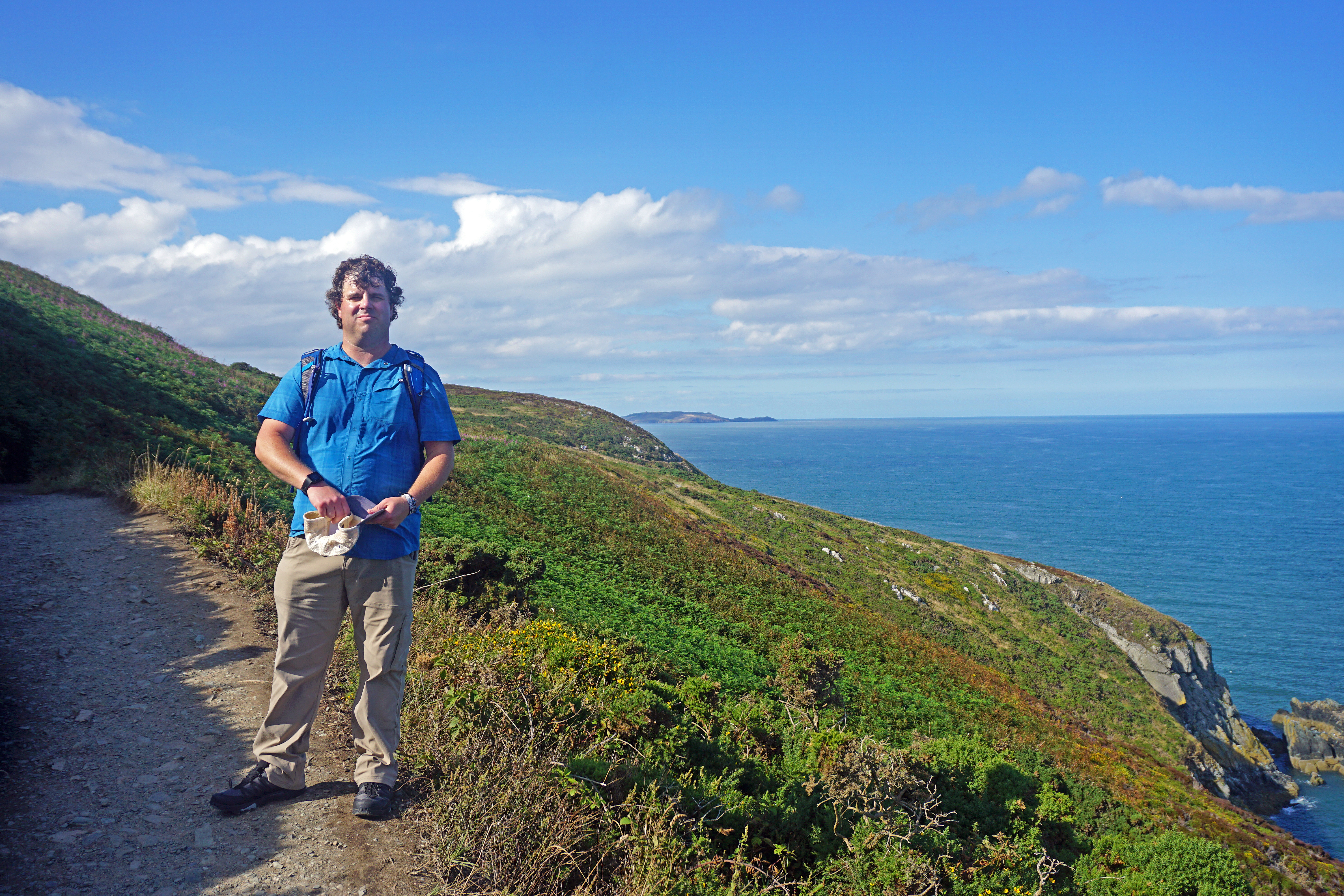
Howth is also known for a famous hike known as the cliff trail, which circles the peninsula. Several planned loops range from approximately four to seven and a half miles (six to twelve kilometers). We had to walk a mile and a half uphill to reach the start of the trail. The trail was hilly, with several ocean cliff views and waves crashing several hundred feet below. For those who have not visited Ireland, it resembled many of the California coastline hikes and landmarks along the Pacific Coast Highway. For much of our hike, we could look back on the town of Howth, where the seawall enclosed the marina and highlighted the features of Pier Street and the lighthouse. It was a spectacle where the most detailed photographs might not capture the illustriousness of the moment.

On our way back to the Howth town center, after hiking several miles, we were hungry again. In addition to a few local beers, Mathew and I shared a joint order of crab claws in savory butter and homemade cocktail sauce at King Sitric Seafood Bar. We felt blessed to eat in this restaurant because it was clear most patrons had reservations, and our wait time was minimal. My mouth continues to water, recollecting and writing about our cuisine experiences in Howth. Our day in Howth might have provided the best food we had during our trip with these two meals.          

Mathew and I felt strongly connected to Dublin and the specific individuals we met during our first week of adventures. Thus, we decided to tour Trinity College at our own pace in more detail than the previously mentioned tour given by Sandeman’s New Dublin. As a prestigious university known by name around the world, Trinity resembles a campus with architecture similar to the Harry Potter school, Hogwarts, which is vividly depicted in the movie series. We then visited the Dubh Lin Gardens one more time before heading back to Egan’s, another distinct famous landmark of the city.

When I was a child, I remember walking through plush, soft grass at my favorite parks, massaging the bottoms of my feet like pillows on my face. The sensation makes me feel connected to nature; the experience created a spiritual connection between my childhood and that present moment in those dignified Dubh Lin nurseries. The grass freshly soothed my feet as I danced around the lawn like a sprite. On this occasion, I felt led to pray that God would bless this stunning place and express my gratefulness for the singular, unprecedented Irish personalities we encountered. On this last day of exploring Ireland, we easily walked (and hiked) another ten-twelve miles in total distance through Howth and Dublin.

Throughout my life, I have learned several lessons from my adventures with international traveling. I have navigated all over the world and thus experienced many different life perspectives. Sometimes people tend to see the world as they want to see it, rather than for what it is. Traveling breaks down a person's paradigm and allows an individual to see the world from other viewpoints. An encounter with culture opens a person’s eyes to real life, and these experiences, therefore, educate a person. It shows the beauty in the shades of gray that define who we are as individuals.

These experiences exhibit that a world exists outside of the United States. To be changed by this external world, an immersion experience in a culture other than your own benefits the traveler with newfound knowledge and information. The distinction between the well-traveled adventurer and a local stateside inhabitant becomes noticeable in how a person communicates, how they behave, and more importantly, what they think. International excursions open a mind to consider the world through the lens of another person’s journey. That open-mindedness is often visible in how an individual addresses another person in conversation.

Traveling outside of the United States enhances personal and professional relationships. When building relationships through cultural experiences, an individual realizes people with opinions other than their own might see things differently yet still live in harmony. In this approach to diplomacy, by the very nature of conflict, discord takes a backseat in efforts extended by people to understand each other. Sometimes there is more than one way of doing things well and maybe even a better way than initially perceived.

Finally, when shared with the right person, these experiences become lifetime memories. Mathew Calhoun is one of my closest friends. On multiple occasions, when I have felt a little down in the past, Mathew has spoken words of hope into my spirit. While together these few weeks, we became close and got to know each other even more than we previously did. 


(Portrait of James on the cliff trail in Howth, Ireland.)


(The Howth Lighthouse and the surrounding waterway on the edge of the town and the marina.)

(An emblem on the stone inside St. Kevin’s Church at the first of the three Aran Islands, named Inis Oirr.)


(The Mutton Island Lighthouse on the outskirts of Galway, Ireland.)


(Another view on one side of the Dubh Linn Gardens.)


(A camera self-portrait in the museum at the Guinness Beer Storehouse.)


(The Poolbeg Lighthouse – tall, bright, and red.)


(A glimpse of the North Bull Lighthouse from the Poolbeg Lighthouse seawall.)


(A sailboat in front of the North Bull Lighthouse, visible from the Poolbeg Lighthouse seawall.)


(A cross tombstone at Inis Oirr.)

(A view of the countryside at Inis Oirr.) 


(A view of the Galway, Ireland coastline.)


(The Dubh Linn Gardens walkway.)


(Mathew and I in the Gravity Bar, atop the roof of the Guinness Beer Storehouse.)

#daddydestinations #daddy #dad #blog #family #travel #internationaltravels #adventures #escapades #destinations #memories #story #narrative #inspiration #JamesCartee #Thanksgiving #goodness #lifelessons #CalhounAndCartee #Ireland #Wales #England #TheUnitedKingdom #UK